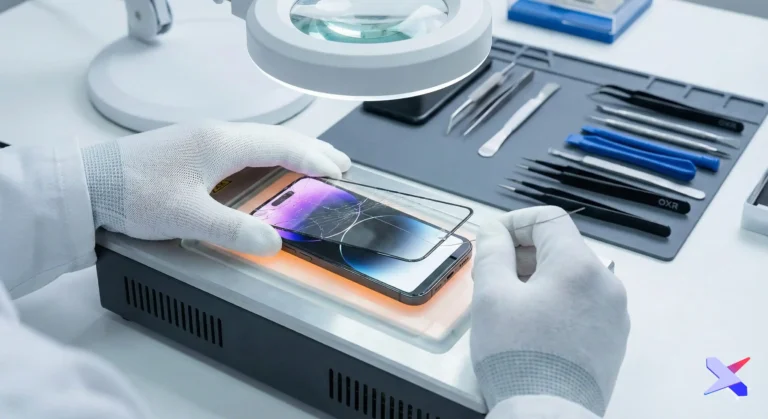
Flawless, Factory-Grade Phone Glass Replacement in Bangalore
Shattered glass doesn't mean a ruined phone. Experience the ultimate precision of OXR’s advanced glass replacement technology. Save your original display, save your money, and get back to life.
Select your Device.
To get started with Display refurbishment.

6 Month warranty.
Data Security +
Doorstep Service
Lowest price guaranteed.
Premium
Parts +
Why OXR is the Ultimate Choice for Glass Replacement in Bangalore
When disaster strikes and your smartphone hits the pavement, it is usually only the top layer of aluminosilicate glass that shatters. The highly valuable LCD or OLED display underneath often remains perfectly functional.
Most repair shops will force you to buy an expensive, full-screen module. At OXR, we do things differently. We specialize in advanced, glass-only repairs. Our certified technicians perform microscopic glass replacement to salvage your original display, saving you significant money while preserving your phone’s true quality.
The OXR Engineering Advantage
Original Display Retention: By keeping your original factory display, your device maintains its exact touch sensitivity, 120Hz refresh rates, and perfect color accuracy.
Massive Cost Savings: A precision glass replacement costs a fraction of what a full-screen assembly swap would cost.
ISO-Standard Cleanroom Environment: We perform our laminations in strictly controlled, dust-free environments to ensure zero particulate contamination.
Advanced Adhesives: OXR uses premium acrylic Optically Clear Adhesives (OCA) that prevent yellowing, peeling, or bubbling over time.
Eco-Conscious Repair: Throwing away a perfectly good OLED panel is a massive waste of e-waste. Repairing only the broken glass makes OXR the sustainable choice for Bangalore.
The OXR Guarantee
Every device that enters our lab undergoes a rigorous, multi-point diagnostic check before and after the repair. We back every glass replacement with our comprehensive OXR warranty.
Ready to restore your phone? Use our seamless, multi-step online booking system to schedule your repair right now.
The Masterclass Guide to Phone Glass Replacement: The Science, The Tools, and The OXR Protocol
Introduction: A cracked phone screen is a modern nightmare. One moment your device is pristine, and the next, it is obscured by a jagged spiderweb of glass. However, if your display still lights up, displays vibrant colors, and responds to your touch, you do not need a whole new screen—you just need a professional glass replacement in Bangalore.
At OXR, transparency is our core value. Whether you are a tech enthusiast, an aspiring technician, or a customer wanting to know exactly what happens to your device, this is the most comprehensive, step-by-step breakdown of the professional glass replacement process available anywhere in the world.
The Anatomy of a Smartphone Display
Before diving into the repair process, it is critical to understand what we are fixing. Modern smartphone screens are “fully laminated,” meaning several distinct layers are fused into one solid block:
The Backlight/Emitter Layer: On an LCD, this is an array of LEDs. On an OLED/AMOLED, each microscopic pixel emits its own light.
The Digitizer: The microscopic grid that registers your touch.
The Optically Clear Adhesive (OCA): A highly specialized, crystal-clear glue that bonds the layers together.
The Front Glass: The outer layer of hardened glass designed to protect the delicate components beneath.
A true glass replacement involves the surgical separation of the shattered outer glass from the delicate OLED/LCD, cleaning it, and re-laminating a new piece of glass.
The Science of Lamination: Why OCA Matters
Why do we glue the glass to the display at all? It comes down to physics and Snell’s Law of Refraction. If there were an air gap between the glass and the display screen, ambient light would bounce around in that gap. This causes glare, a hollow tapping sound, and a reduction in screen brightness by up to 12%.
By using an Optically Clear Adhesive (OCA) with a refractive index perfectly matched to the glass (around 1.4 to 1.5), we eliminate light refraction. The image looks like it is painted directly onto the glass. OXR exclusively uses premium sheet-form OCA, avoiding the messy, uneven curing issues associated with older Liquid Optically Clear Adhesives (LOCA).
The OXR Cleanroom Standard
Glass replacement cannot be done on a dusty workbench. A single speck of dust trapped under the glass will cause a permanent, highly visible air bubble.
OXR technicians operate under strict anti-particulate protocols. We manage temperature (around 23°C) and control humidity (around 40% RH) to prevent static electricity from frying delicate Micro-LEDs or OLED panels. We utilize lint-free, Class-10,000 cleanroom microfiber cloths and 99.9% Isopropyl Alcohol to ensure a surgically clean surface.
The 12-Step OXR Glass Replacement Masterclass Protocol
Step 1: Intake and Multi-Point Diagnostic Before any tools are lifted, the phone is tested. We check touch sensitivity across the entire grid, look for dead pixels, and ensure the underlying panel is perfectly healthy and ready for a glass replacement.
Step 2: Device Disassembly and Power Isolation The device is powered down. Using targeted thermal heat and specialized spudgers, the back glass or housing is removed. The battery is immediately disconnected to prevent electrical shorts. All flex cables are carefully unseated, and the broken screen module is removed from the chassis.
Step 3: Thermal Softening The separated screen module is placed face-down on a specialized heat plate separator. The machine is dialed precisely between 80°C and 90°C. This specific temperature range safely softens the factory OCA bonding the glass without burning the delicate liquid crystals or organic diodes beneath.
Step 4: Molybdenum Wire Cleaving Once the screen is heated, a vacuum pump engages to lock the display in place. The technician takes a microscopic, high-tensile molybdenum cutting wire (often just 0.08mm thick) and hooks it between the shattered glass and the OLED. Using a smooth, sweeping motion, the wire slices through the softened OCA.
Step 5: Gross Adhesive Removal With the shattered glass discarded, the bare display is left covered in a thick, sticky layer of old OCA. The technician uses a low-speed, motorized adhesive removal wand to carefully roll the bulk of the glue off the delicate panel.
Step 6: Cleanroom Grade Polishing The display is moved into the cleanroom environment. The technician uses 99.9% Isopropyl Alcohol and anti-static microfiber pads to polish the screen. This step is repeated until the screen is absolutely pristine under harsh inspection lights.
Step 7: OCA Application A fresh sheet of premium acrylic OCA is applied to the bare display. Using a manual, dust-free silicone roller, the adhesive is pressed down with exact, even pressure to ensure no major creases or structural bubbles occur.
Step 8: Precision Glass Alignment The protective backing is peeled off the newly applied OCA. A brand-new, factory-grade glass panel—treated with a premium oleophobic coating to resist fingerprints—is placed into a device-specific alignment mold. The OLED display is perfectly dropped into the mold, mating it to the new glass.
Step 9: Vacuum Press Lamination The mated screen is placed into an industrial vacuum laminator. The machine seals itself and pumps out all oxygen, creating a complete vacuum. A heated silicone press then forcefully stamps down, bonding the glass, OCA, and display together seamlessly.
Step 10: High-Pressure Autoclave Curing Even with vacuum lamination, microscopic air bubbles can remain. The screen is transferred into an autoclave bubble-removal chamber. For 10 to 15 minutes, the screen is blasted with compressed air (upwards of 100 PSI) and mild heat. This immense pressure forces any remaining air to dissolve entirely into the OCA matrix, resulting in crystal clarity.
Step 11: Reassembly and Sealing The fully refurbished screen is reconnected to the phone’s motherboard. New water-resistant adhesive seals are applied to the phone’s chassis, and the device is meticulously screwed back together.
Step 12: Final Quality Assurance The phone is powered on. OXR technicians run a final stress test on the display, checking maximum brightness, color accuracy, and multi-touch functionality to ensure the device feels exactly as it did the day it left the factory.
Trust Your Device to the OXR Experts
As you can see, professional glass replacement is a highly scientific, equipment-heavy process. Attempting this at home without vacuum laminators, autoclaves, and cleanroom disciplines almost always results in a destroyed display.
When your screen shatters, don’t compromise. Trust the engineers at OXR to restore your device to perfection.
OXR is India’s First Brand to-
-Maintain service history
-Replace Void Warranty
-QC and Device health record